
Norfolk Southern Railway (NS) | Overview, History, Today
Appalachian-Railroads Navigation: Home Page
- Railroad Overview | Route Comparison
- Legacy: B&O | C&O | Clinchfield | L&N | NC&StL | N&W | PRR | SOU | VGN
- Early: 3Cs | ET&WNC | LC&C | Blue Ridge | More
- Related: ACL | SAL | SCL
- Northern: DL&W | Erie | Erie Lack | NYC | P&LE | Reading | Western MD | W&LE
- Short: G Mid | K&T | Tallulah | More
- Consolidation: Chessie | Family | Penn Cen | Conrail | Seaboard
- Today: CSX | Norfolk Southern | Amtrak
- Abandoned | Railfan Guides | Rail Trails
- Railroad Cities/Towns | Mtn Gaps/Passes
- Resources: Bibliography & Further Reading | Authors | Books | Museums | Organizations | Links
- Model Railroads: 3Cs | ET&WNC
- Website: Site Map | Editor
- Clinchfield.org | Southern-Railroads.org
Page Contents
Norfolk Southern Railway – NS
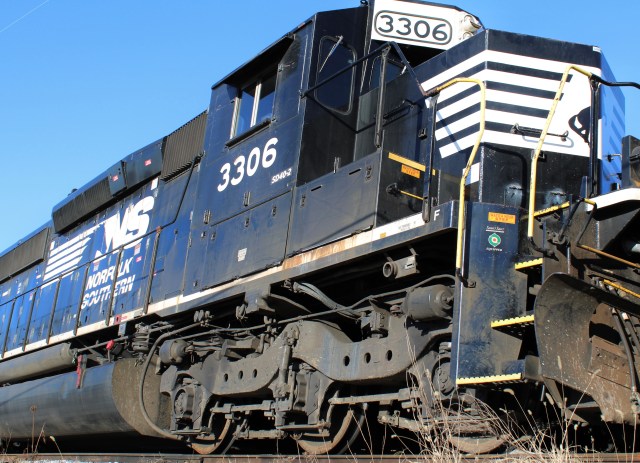
Two legacy Appalachian railroads
For many years Norfolk & Western and Southern Railways were two Appalachian Railroads that enabled prosperity for the region. Southern’s rail lines fanned out across the south bringing freight and passengers north to south, and vice versa. Conversely to Southern, Norfolk & Western operated in a perpendicular fashion crossing the mountains and connecting the eastern seaboard with the mid-west. Even with industry leading financial and operating performance through out the 1900s, the Norfolk & Western and Southern Railways realized by 1980 that consolidation was the only pathway to continued success.
The foundation: 1980s and the great Eastern consolidation
The journey of Norfolk Southern (NS) officially began in 1982, but its roots trace back to the landmark deregulation of the U.S. railroad industry by the Staggers Rail Act of 1980. This legislation removed many of the strict regulations that had hobbled railroads for decades, allowing for more flexible pricing and route abandonment. It spurred a wave of mergers as railroads sought to consolidate and streamline their operations.
The creation of Norfolk Southern was a direct response to this new environment. In 1980, the Southern Railway and the Norfolk and Western Railway, two strong and profitable carriers, announced their intention to merge. The move was spurred by the formation of rival CSX Corporation, which combined the Chessie System and the Seaboard System. On June 1, 1982, the Norfolk Southern Corporation was officially formed as a holding company, bringing the two railroads under one umbrella. The merger created a powerful network spanning the southeastern and midwestern United States.
The early years focused on integration and network optimization. In 1985, NS began repainting locomotives in a common scheme to present a unified brand, though the two predecessors continued to operate as separate subsidiaries until the full merger in 1990. In a key move towards diversification, NS acquired North American Van Lines in 1986 to enter the trucking business, though it would later divest this in 1996 to focus on its core rail operations.
The Conrail era: Reshaping the Northeast
The most defining event of the 1990s for Norfolk Southern was the joint acquisition and dismemberment of Conrail with its rival, CSX. Conrail was a government-created railroad formed from the remains of several bankrupt northeastern railroads in 1976. Following deregulation, Conrail became profitable and was privatized, setting the stage for its eventual takeover.
The bidding war for Conrail began in 1997, with both NS and CSX vying for control. The situation was complex and fraught with political considerations, as a single-owner acquisition could have created an Eastern rail monopoly. The solution was an agreement to divide the railroad’s assets. NS ultimately acquired 58% of Conrail’s assets, including the valuable former Pennsylvania Railroad lines that extended its network deep into the Northeast, serving major industrial centers like New York, Philadelphia, and Detroit.
The acquisition, completed in 1999, was a transformative moment for Norfolk Southern. It expanded NS’s network by 50%, providing crucial access to densely populated and industrially significant regions. The integration of the Conrail assets was a massive undertaking, but it cemented NS’s status as a major player in the Eastern U.S. freight market, providing increased competition and expanded market reach.
The 21st century: Efficiency, intermodal, and technology
Following the Conrail acquisition, the industry continued to evolve, and Norfolk Southern’s strategy shifted to reflect new realities.
Operational efficiency and cost reduction
The early 2000s saw a focus on consolidating operations and investing in technology and infrastructure. However, the late 2010s brought a significant operational shift with the adoption of Precision Scheduled Railroading (PSR). While initially resisted by NS, the success of rival CSX under the architect of PSR, Hunter Harrison, forced a re-evaluation. PSR is an operating model focused on increasing efficiency by running fewer, longer, and more profitable trains on a fixed schedule, which theoretically reduces costs and improves service reliability. While it initially improved financial metrics, critics argued it came at the cost of service quality, employee morale, and safety.
Intermodal growth
The rise of containerized shipping and global supply chains fundamentally changed freight transport. Norfolk Southern responded by making intermodal transportation a major focus of its strategy. The company developed extensive intermodal facilities near major ports and urban centers to efficiently transfer containers between ships, trucks, and trains. This positioned NS to capitalize on the fast-growing intermodal market and adapt to the “reshoring” trend of recent years, which has seen domestic manufacturing expand. A key achievement was the opening of the Heartland Corridor in 2010, which facilitated faster double-stack intermodal service between the East Coast and the Midwest.
Technology
Norfolk Southern has increasingly relied on technology to drive efficiency and safety. This includes the implementation of Positive Train Control (PTC) systems to prevent accidents, as well as the use of data analytics and artificial intelligence for predictive maintenance. It has also deployed autonomous track inspection systems and machine vision technology to detect potential safety defects on trains.
A defining moment: The East Palestine derailment and its aftermath
The evolution of Norfolk Southern took a dramatic and tragic turn in February 2023 with the derailment of a train in East Palestine, Ohio. This incident, involving a hazardous materials release and subsequent controlled burn, had far-reaching consequences for the company.
The derailment brought intense public and regulatory scrutiny, revealing issues with safety practices and communication. The National Transportation Safety Board (NTSB) criticized NS’s operating procedures and its initial response to the incident. In the wake of the disaster, NS faced significant financial liabilities and reputational damage.
In response, the company has embarked on a safety transformation, committing to comprehensive changes in its operations and culture. Key actions have included:
- Enhanced Safety Protocols: Working with unions and regulators to revise and strengthen safety protocols.
- Increased Technology Investment: Accelerating the deployment of technologies like the machine visioning train inspection portals to proactively identify defects.
- Improved Employee Empowerment: Introducing confidential reporting systems for safety issues and increasing engagement with frontline workers.
- Community Engagement: Investing in community support and first responder training.
Four decades as Norfolk Southern
In the last four decades, Norfolk Southern Railway has transformed from a newly formed merger of regional carriers into a modern freight giant, navigating deregulation, aggressive mergers, a changing economy, and the rise of digital technology. This period has been defined by strategic acquisitions, a shifting operational focus from traditional freight to intermodal transport, and an increasing, if sometimes challenged, emphasis on safety and efficiency.
The potential for a transcontinental future
In a development that signals a new era of rail consolidation, Norfolk Southern’s future took a dramatic and uncertain turn with the proposed $85 billion acquisition by its rival, Union Pacific (UP). Announced in late July 2025, the deal would see NS absorbed into a combined entity, creating America’s first truly transcontinental railroad under a single owner. Proponents argue the merger would increase efficiency, eliminate interchange delays at bottlenecks like Chicago, and provide faster, more competitive service for shippers. The proposal, however, faces intense regulatory scrutiny from the Surface Transportation Board (STB) and pushback from rail unions and some politicians concerned about reduced competition and potential impacts on service quality and safety.
The announcement of the UP-NS merger immediately triggered a competitive response from the other two major U.S. freight railroads, BNSF Railway and CSX. Rather than pursue their own full merger, BNSF and CSX announced a joint initiative to expand their intermodal service offerings in August 2025. This partnership includes new coast-to-coast connections linking Southern California to the East Coast, as well as new international intermodal services.
Norfolk Southern in transition
Today, Norfolk Southern is a company in transition. Still a powerhouse in bulk commodities and intermodal transport, it is now emerging from the shadow of the East Palestine derailment, which has mandated a renewed and intense focus on safety and customer-centric operations. The railroad’s strategic path forward involves balancing efficiency with safety, leveraging technology to improve operations, and meeting the growing demands of both customers and consumers. However, this path is now fundamentally shaped by the proposed acquisition by Union Pacific, a move that could either redefine Norfolk Southern’s legacy or become one of the most contentious moments in modern rail history. How it successfully navigates these challenges will not only define its future but also serve as a barometer for the broader freight rail industry in the coming years.
