
C&O | Coal Operations
- Site Navigation: Home Page
- Railroad Overview | Route Comparison
- Legacy: B&O | C&O | Clinchfield | L&N | NC&StL | N&W | PRR | SOU | VGN
- Early Lines: 3Cs | ET&WNC | LC&C | More
- Related: ACL | SAL | SCL
- Northern: DL&W | Erie | Erie Lack | NYC | P&LE | Reading | Western MD | W&LE
- Short Lines: G Mid | K&T | Tallulah | More
- Consolidation: Chessie | Family | Penn Cen | Conrail | Seaboard
- Today: CSX | Norfolk Southern | Amtrak
- Abandoned | Railfan Guides | Rail Trails
- Railroad Cities/Towns | Mtn Gaps/Passes
- Resources: Authors | Books | Museums | Organizations | Links
- Model Railroads: 3Cs | ET&WNC
- 3Cs: Site Map | Editor
- Clinchfield.org | Southern-Railroads.org

Page Contents
Chesapeake & Ohio Railway Coal Operations
Chesapeake & Ohio (C&O) Railway, historically known as a “coal-hauling juggernaut,” played a foundational role in the industrialization of the United States by linking the rich bituminous coalfields of the Appalachian Mountains to the global market.
19th Century: Forging the “Black Gold” Route
The C&O’s roots trace back to the Louisa Railroad, chartered in 1836. Following the Civil War, the line merged with the Covington & Ohio in 1868 to form the Chesapeake and Ohio. Under the leadership of industrialist Collis P. Huntington, the railway achieved a monumental engineering feat: crossing the Allegheny Mountains to reach the Ohio River in 1873 at a new city named Huntington, West Virginia.
In 1882, the railroad completed a critical 75-mile extension to Newport News, Virginia. This created a direct pipeline from the mines to the East Coast’s largest ice-free port, establishing coal as the company’s primary commodity. By 1889, the acquisition of the Richmond & Alleghany Railroad provided a “water level” route along the James River, allowing heavy coal trains to bypass steep mountain grades—a path that remains a primary coal artery today.
Geography of the Coal Districts
The heart of the C&O’s operations lay in the “smokeless” and high-volatile coal districts of Central Appalachia. The railroad’s network was strategically woven into four primary regions:
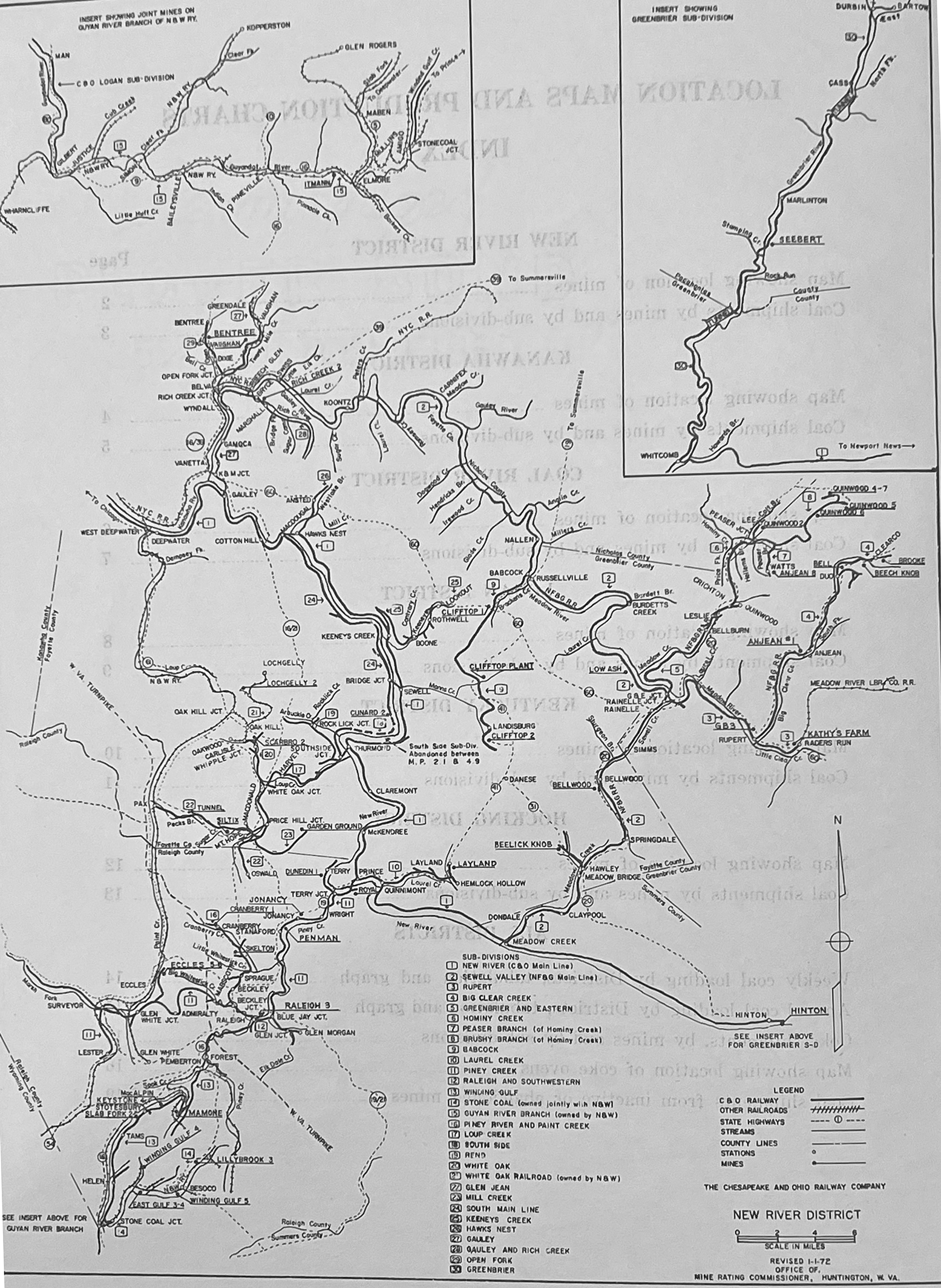
- New River District: Located in Fayette and Raleigh counties, West Virginia, this region produced high-quality, low-volatile “smokeless” coal essential for navies and heating.
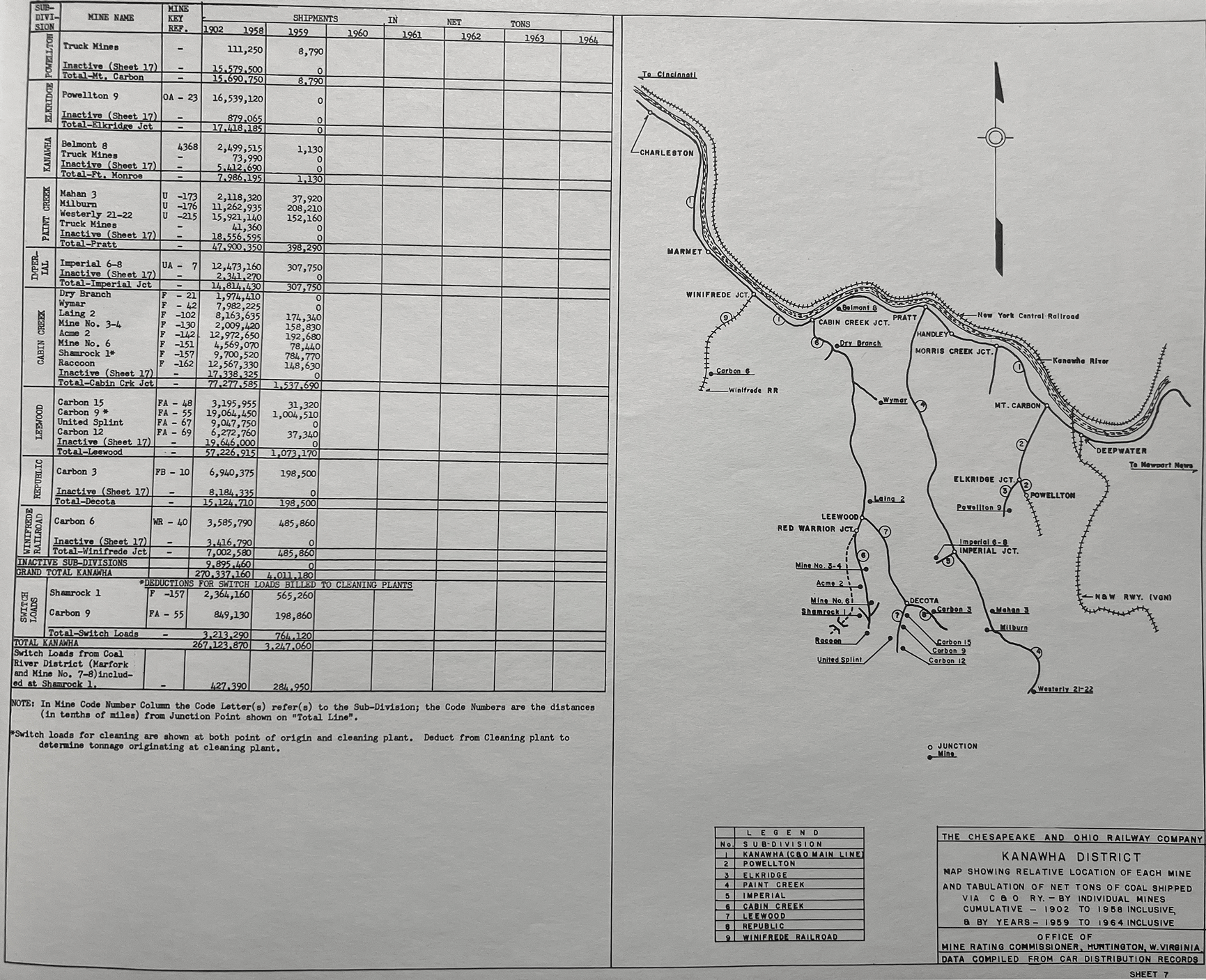
- Kanawha District: Stretching along the Kanawha and Coal River valleys, this area provided massive quantities of steam and gas coal.
- Logan District: Centered around Logan County, this became one of the C&O’s most productive regions in the early 20th century, following the construction of the Guyandot Valley extension.
- Big Sandy District: Reaching into eastern Kentucky (Floyd, Pike, and Johnson counties), this district tapped into the rich Elkhorn coal seams, further diversifying the C&O’s energy portfolio.
20th Century: The Steam and Steel Era
The early 1900s marked the peak of expansion. Between 1900 and 1920, the C&O built dozens of branch lines to tap previously isolated coal seams in southern West Virginia and eastern Kentucky. This infrastructure supported the massive fuel demands of World War I and II, as well as the booming American steel industry.
The C&O was a leader in locomotive technology, developing massive steam engines like the 2-6-6-6 Allegheny to pull million-ton loads over mountain peaks. Even during the Great Depression, while 50% of American railroads faced receivership, the C&O remained profitable thanks to the constant national demand for coal. By the 1950s, the transition to diesel engines reduced maintenance needs, fundamentally altering the economics of railroad towns like Hinton, West Virginia.
The Modern Era: CSX
Today, the former C&O network remains a cornerstone of the CSX rail system. While coal volumes have fluctuated with changing energy markets, the James River Line and the Appalachian branches continue to move significant tonnage. Modern operations utilize high-tech innovations like distributed power, where locomotives are placed in the middle of 200-car trains to safely transport massive loads across the historic C&O mainline.
Location Maps and Production Charts
Coal Maps and Charts from the Scott Jessee Collection


For More Information – Sources and Resources
The following are excellent resources for those of you wanting to explore and learn more about the history and operation of the Appalachian Railroads. These sources of information also serve as reference and historical materials for Appalachian-Railroads.org. Much of the collective railroad history data points on this website are verified across multiple sources.
- Personal Maps & Memorabilia: Documents, maps, timetables, and track charts
- Associations, Historical Societies and their Archives
- ACL & SCL Railroads Historical Society
- Baltimore & Ohio Railroad Historical Society
- Chesapeake & Ohio Historical Society
- Carolina Clinchfield Chapter National Railway Historical Society
- ET&WNC Railroad Historical Society and their Facebook Page
- George L. Carter Railroad Historical Society (Johnson City Railroad Experience)
- Louisville & Nashville Railroad Historical Society
- Norfolk & Western Historical Society
- Pennsylvania Railroad Technical and Historical Society
- Southern Railway Historical Association
- Watauga Valley Railroad Historical Society
- Archives of Appalachia: ETSU, Johnson City TN
- Newspaper Articles: Newspapers.com
- Magazines/Online: ‘Trains‘, ‘Classic Trains‘
- Books
- Drury: The Historical Guide to North American Railroads
- Appalachian Region
- Grant: ‘The Louisville, Cincinnati & Charleston Rail Road’
- Graybeal: ‘The Railroads of Johnson City
- Huddleston: ‘Appalachian Crossings – The Pocahontas Roads‘ and ‘Appalachian Conquest‘
- Poole: ‘A History of Railroading in Western North Carolina‘
- Timko and Young: ‘Appalchian Coal Mines and Railroads, Vol. 1, 2, & 3‘
- Roberts: ‘Sand Patch, Clash of the Titans‘
- Yanosey: ‘Tidewater Triangle’
- Atlantic Coast Line Railroad
- Calloway: ‘Atlantic Coast Line, The Diesel Years‘
- Griffin: ‘Atlantic Coast Line, The Standard Railroad of the South‘
- Goolsby: ‘Atlantic Coast Line Passenger Service, The Postwar Years‘
- Baltimore & Ohio Railway
- Jacobs: ‘The History of the Baltimore & Ohio’
- McGuirk: ‘Baltimore & Ohio Railroad in the Potomac Valley‘
- Ori, Salamon and Oroszi: Baltimore & Ohio/Reflections of the Capitol Dome‘ and ‘Baltimore & Ohio/Sunburst Trail to Chicago’
- C&O Railway/Chessie System
- Dixon: ‘Chesapeake & Ohio, Superpower to Diesels‘, Chesapeake & Ohio in the Coalfields, ‘C&O Allegheny Subdivision‘, and ‘Chesapeake & Ohio Railway – A Concise History and Fact Book‘, and ‘The Chessie Era’
- Dorin: ‘The Chesapeake & Ohio Railway’
- Huddleston: ‘Riding the New River Train‘
- Ori – ‘Chessie System‘
- Paton: ‘Allegheny with an A’
- Turner: ‘Chessie’s Road‘
- Clinchfield Railroad
- Beach: ‘The Black Mountain Railway’
- Goforth: ‘Building the Clinchfield‘ and ‘When Steam Ran the Clinchfield‘
- Helm: ‘The Clinchfield Railroad in the Coal Fields‘
- Irwin & Stahl: ‘The Last Empire Builder: The Life of George L. Carter‘
- King: ‘Clinchfield Country‘
- Marsh: ‘Clinchfield in Color‘
- Poteat & Taylor: ‘The CSX Clinchfield Route in the 21st Century‘
- Stevens & Peoples: ‘The Clinchfield No. 1 – Tennessee’s Legendary Steam Engine‘
- Way: ‘The Clinchfield Railroad, the Story of a Trade Route Across the Blue Ridge Mountains‘
- CSX Railroad
- Springirth: ‘CSX Transportation Heritage‘
- ET&WNC: Listed on the website’s ET&WNC pages
- Interstate Railroad
- Wolfe & Wolfe: ‘Appalachian Coal Hauler’
- Wolfe: ‘The Interstate Railroad‘
- L&N Railroad
- Castner, Flanary & Dorin: Louisville & Nashville Railroad The Old Reliable‘
- Flanary: The Louisville & Nashville Cumberland Valley Division
- Flanary, Oroszi & McKee: ‘The Louisville & Nashville in the Appalachians‘
- Oroszi & Flanary: ‘Dixie Lines, The Louisville & Nashville Railroad‘
- NC&StL Railway
- Prince: ‘Nashville Chattanooga & St Louis Railway‘
- Norfolk Southern
- Esposito: ‘Norfolk Southern Railroad’
- Lindsey: ‘Norfolk Southern 1995 Review‘
- Norfolk & Western Railway
- Newton: ‘Rails Remembered, Volumes 1-6
- Warden: ‘Norfolk & Western: Diesel’s Last Conquest‘ and ‘Norfolk & Western’s Passenger Service’
- Wolfe, Wilson & Mandelkern: ‘Norfolk & Western’s Clinch Valley Line‘
- Pennsylvania Railroad
- Jacobs: ‘The History of the Pennsylvania Railroad‘
- Seaboard Air Line, Seaboard Coast Line, Seaboard System
- Calloway and Withers: ‘Seaboard Motive Power‘
- Carleton: ‘Locomotives of the Seaboard System‘
- Griffin: ‘Seaboard Coast Line and Family Lines Railroad‘ and ‘All Lines North of Raleigh‘
- Johnson: ‘Through the Heart of the South‘
- Southern Railway
- Davis: The Southern Railway, Road of the Innovators‘
- Flanary, Lindsey & Oroszi. The Southern Railway‘
- Webb: ‘The Southern Railway System: An Illustrated History‘
- Wolfe: ‘Southern Railway Appalachia Division‘
- Virginian Railway
- Reisweber: ‘Virginian Rails’
- Wiley & Wallace: ‘The Virginian Railway Handbook‘
- Online Article: Flanary: ‘The Quick Service Route, The Clinchfield Railroad‘; Scientific American: ‘The Costliest Railroad in America‘
- Online Videos: Ken Marsh on Kingsport area railroads and region’s history Video #1 | Video #2:
- Websites:
- American-Rails.com
- AppalachianRailroadModeling.com
- Carolana.com – North Carolina Railroads, South Carolina Railroads
- Diesel Shop
- HawkinsRails.net
- Multimodalways
- StateOfFranklin.net which hosts Johnson’s Depot
- RailFanGuides.us for Johnson City and for Erwin
- SteamLocomotive.com
- VirginiaPlaces.org – Railroad History of Virginia
- Wikipedia.org
- WvncRails.org – North Carolina and West Virginia Railroads
3Cs Websites
Appalachian-Railroads.org | Clinchfield.org | Southern-Railroads.org
